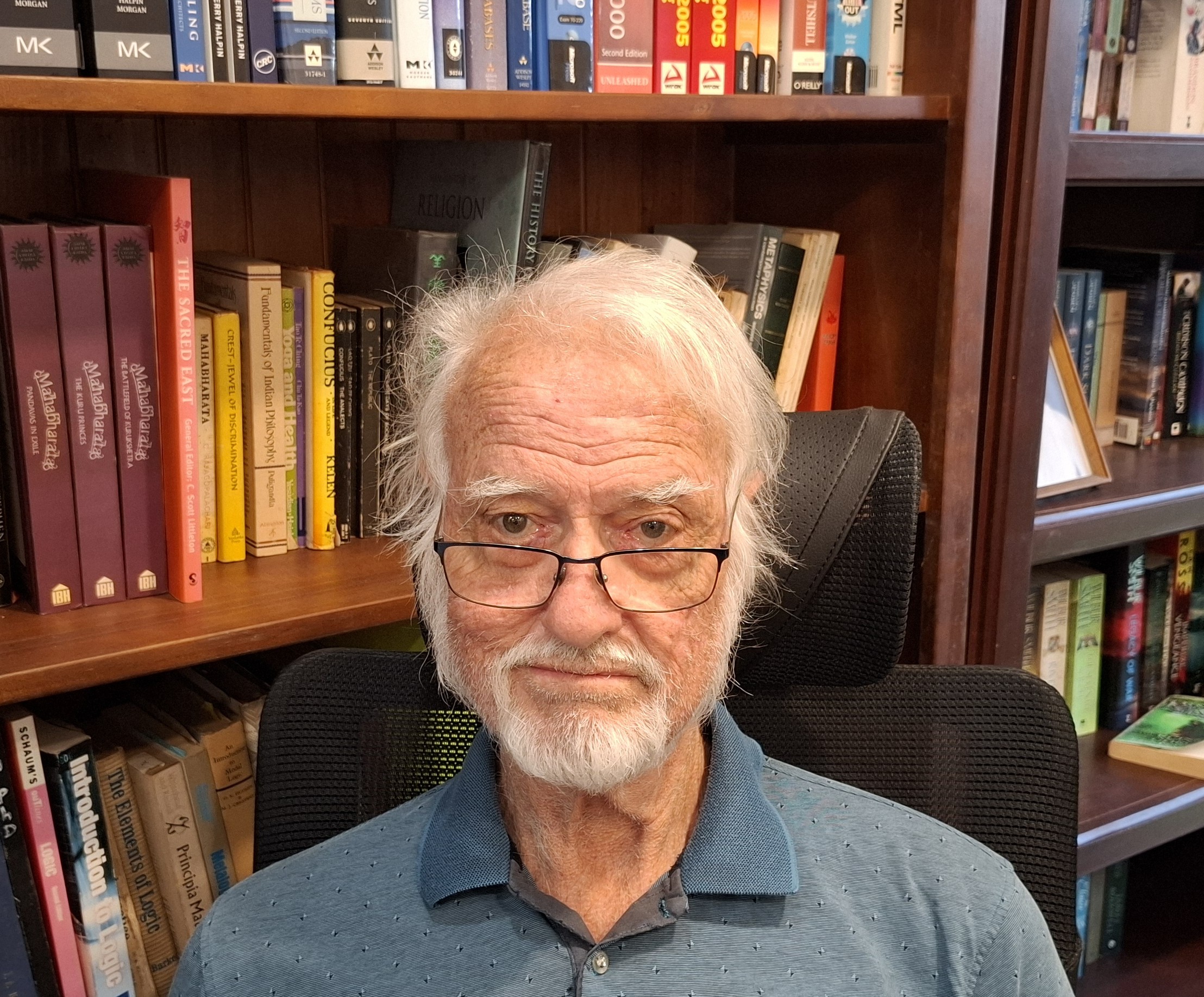
Terry Halpin
Peter Chen Award Laureate
Dr. Terry Halpin is internationally recognized as the leading authority on Object-Role Modeling (ORM). His academic career included senior lecturer and professor positions in Australia, as well as professorships in computer science at universities in the USA and Malaysia. His industry experience includes several years in data modeling technology at various companies including Microsoft Corporation. He later worked as a research scientist at LogicBlox, and as a data modeling consultant for the European Space Agency. His research focuses on conceptual modeling and conceptual query technology.
Dr. Halpin is the recipient of the DAMA International Academic Achievement Award (2003), the IFIP Outstanding Service Award (2006), and was recognized as an ER Fellow (2024).
He is a member of IFIP WG 8.1 (Design and Evaluation of Information Systems), is an editor or reviewer for several academic journals and international program committees, has co-chaired several international workshops on modeling, and has presented at dozens of international conferences in both industry and academia. For many years, his research has focused on conceptual modeling and conceptual query technology for information systems, using a business rules approach. His doctoral thesis formalized Object-Role Modeling (ORM/NIAM), and his publications include over 200 technical papers, and ten books, including Information Modeling and Relational Databases.
Object-Role Modelling: An Historical Overview
Object-Role Modelling (ORM) is a fact-oriented approach for designing information models at the conceptual level, using terms easily understood by non-technical users. ORM includes procedures for mapping an ORM model to various logical or physical data models (e.g. relational, object-oriented, logic-programming, ontological, XML), and for reverse engineering some of these models to an ORM conceptual model. In ORM, a fact is an atomic proposition taken to be true by the user community. An atomic fact can’t be split into simpler facts with the same object types without information loss. A fact is either existential (asserting an individual object’s existence) or elementary (asserting that an object has property or that one or more objects participate in a relationship). Unlike Entity-Relationship (ER) modelling and the Unified Modeling Language (UML), fact-oriented modelling is attribute-free: elementary facts are expressed simply in terms of objects playing roles in a unary or longer relationship. For modelling information, ORM’s graphical notation for visualizing the model is arguably more expressive than other notations, and it can be automatically verbalized in natural language. This presentation briefly outlines the origin and development of ORM, providing coverage of its capabilities using both examples and tool demonstrations. Finally, some possible modifications to ORM are considered.